Approach and Landing
1. Inbound flight path should not require more than a 20 degree bank angle to follow noise abatement track.
2. Observe all airspeed limitations and ATC instructions.
3. Initial inbound altitude for noise abatement areas will be a descending path from 2,500 feet AGL or higher. Maintain minimum airspeed (1 .3Vs+20 KIAS) with gear retracted and minimum approach flap setting.
4. At the final approach fix (FAF) or not more than 4 miles from runway threshold, extend landing gear. Final landing flap configuration should be delayed at pilot’s discretion to enhance noise abatement.
5. During landing, use minimum reverse thrust consistent with safety for runway conditions and available length.

Graphic provided by www.NBAA.com
These NBAA noise procedures are recommended as standard for all operations where aircraft manufacturers have not recommended specific procedures. The NBAA procedures are to supplement and be complementary to established noise abatement programs containing procedures and techniques for specific aircraft.
When professional opinion indicates that the procedures and techniques recommended for specific aircraft are less effective than the NBAA procedures, pilots are encouraged to contact the manufacturers and airport management with specific recommendations for change.
Departure:
NBAA-RECOMMENDED NOISE ABATEMENT DEPARTURE PROCEDURE WITH HIGH-DENSITY AIRPORT OPTION
1. Climb at maximum practical rate not to exceed V2+20 KIAS (maximum pitch, attitude 20 degrees) to 1,000 feet AAE (800 ft. AAE at high-density-traffic airports) in takeoff configuration at takeoff thrust.
2. Between 800 and 1,000 feet AAE, begin acceleration to final segment speed (VFS or VFTO) and retract flaps. Reduce to a quiet climb power setting while maintaining a rate of climb necessary to comply with IFR departure procedure, otherwise a maximum of 1,000 FPM at an airspeed not to exceed 190 KIAS, until reaching 3,000 feet AAE or 1,500 feet AAE at high-density-traffic airports. If ATC requires level off prior to reaching NADP termination height, power must be reduced so as not to exceed 190 KIAS.
3. Above 3,000 feet AAE (1,500 feet at high-density airports) resume normal climb schedule with gradual application of climb power.
4. Ensure compliance with applicable IFR climb and airspeed requirements at all times.
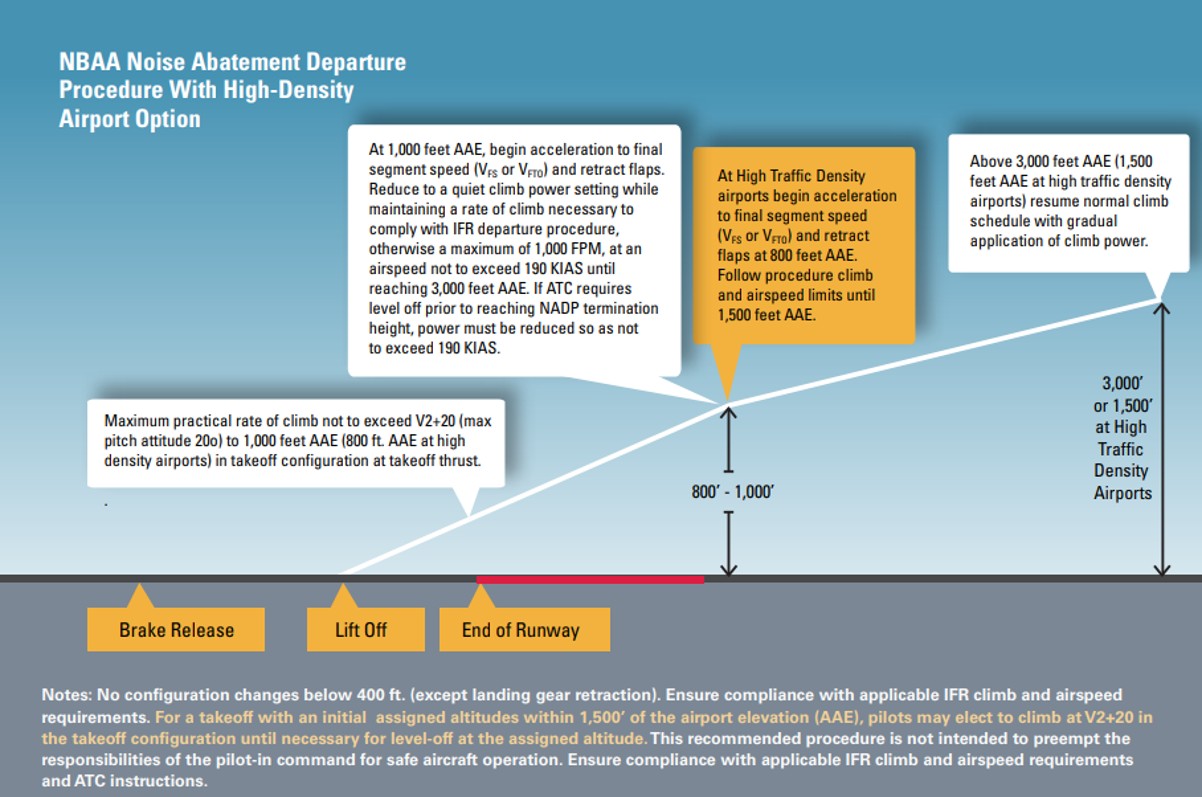
Graphic provided by www.NBAA.com
Fly assigned ATC heading or standard departure procedure. If no heading or departure procedure is assigned, turn right to a heading of 360° for two miles before proceeding on course.

